




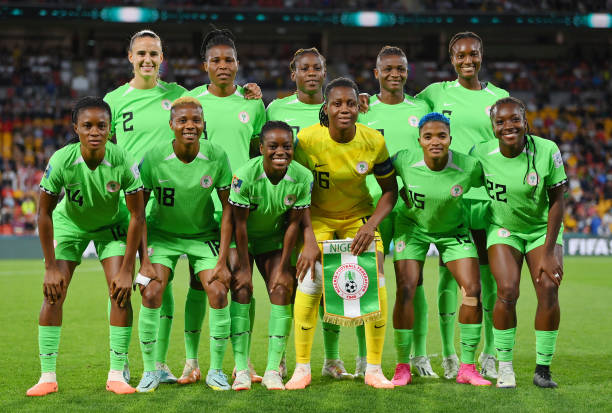
Compared to the Super Eagles, the Super Falcons of Nigeria have undoubtedly been the main source of joy for Nigerian football enthusiasts in the past few months. Their efforts culminated in ending a 16-year absence at the Olympics in April.
Nigeria outwitted their continental rival and reigning African champions South Africa, to secure their spot at the Paris 2024 Olympics scheduled to begin Friday, July 26 until Sunday, August 11, 2024.
Captain Rasheedat Ajibade’s penalty was enough for the Super Falcons to defeat the Banyana Banyana over a two-legged fixture, further justifying the Nigeria Football Federation’s (NFF) decision to extend Randy Waldrum’s contract in 2023.
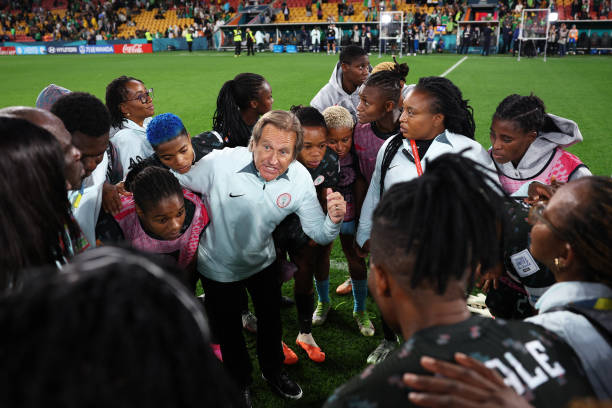
Now that the qualification euphoria has settled, and the team has landed in Bordeaux where they’ll play their first match against Brazil, Nigeria’s infamous history at the Olympics comes to the fore.
Super Falcons’ lacklustre presence on the Olympic stage
After making the World Cup quarter-final in 1999 — Africa’s best finish to date – Super Falcons’ first-ever appearance at the Olympics in 2000 ended in an expected group stage ouster. The team lost all three matches to China, eventual winners Norway and silver medalist USA. Their return four years later was more eventful, as they navigated their way past Japan and hosts nation Greece in the group stage, before losing 2-1 to Germany in the quarterfinals.
While the Anthens 2004 quarterfinal finish was Nigeria, and Africa’s best finish at the women’s Olympics Football Tournament, the Falcons, as it turned out, failed to capitalise on their breakthrough in the next edition. Nigeria’s campaign at the Beijing 2008 Olympics mirrored their 2000 run, as they lost all their group-stage matches.
How it turned out from there is no news. Nigeria missed the next three Olympics from 2012 to 2020, until now, when a new generation of Falcons will look to build on the legacy of the Athens 2004 Falcons in Paris.
Super Falcons chances at the Paris 2024 Olympics
The Super Falcons have proven they’re no pushovers against foreign opposition with their commendable performance at the 2023 Women’s World Cup. The nine-time African champions went undefeated in the group stage, securing goalless draws against Canada and the Republic of Ireland, and a thrilling 3-2 victory over co-host Australia.
The Waldrum-led ladies advanced as the second team in Group B, earning them a Round-of-16 clash with England. Despite being ousted 4-2 on penalties by the Lionesses, Nigeria’s campaign was anything but disappointing.
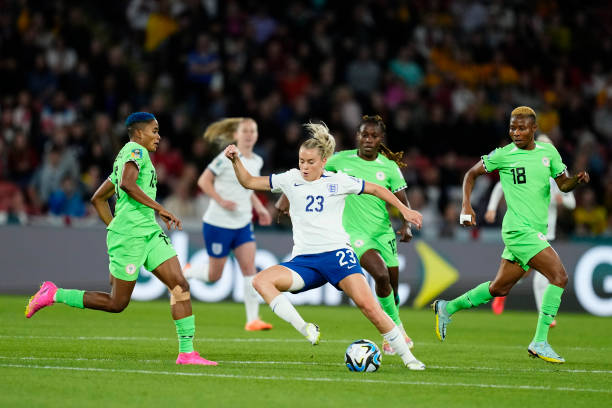
Taking precedent from the Mundial run to build a better Olympics campaign seems like the logical thing to do, but Nigeria’s status as an underdog in Group C stirs a familiar disappointing feeling.
The Super Falcons face a difficult task in Group C, pitted against two-time Olympic silver medalists Brazil, current World Cup holders Spain, and 2011 champions Japan. In terms of competitive preparation, the Falcons appear untested. Their only pre-tournament test was a 1-0 friendly loss to Canada on Wednesday. In contrast, their first opponent, Brazil, comes into the tournament with two emphatic 4-0 victories over Jamaica in June.
Japan defeated Ghana 4-0 in a friendly fixture on July 13, and the Nadeshiko are set for another test against Columbia later on Friday. Although Spain didn’t play any friendly games, the World champions are the best match-ready side of the four teams. Earlier in July, they recorded a 2-0 win over Belgium and a 2-1 loss to the Czech Republic in the 2025 Women’s Euro qualification campaign.
A simple eye test shows the Falcons are not only the underdogs in Group C, but are also the least prepared. Regardless, if there’s any women’s team from Africa that can defy odds like this, it’s certainly Nigeria. But expectations have to be curtailed for obvious reasons.








Leave a comment